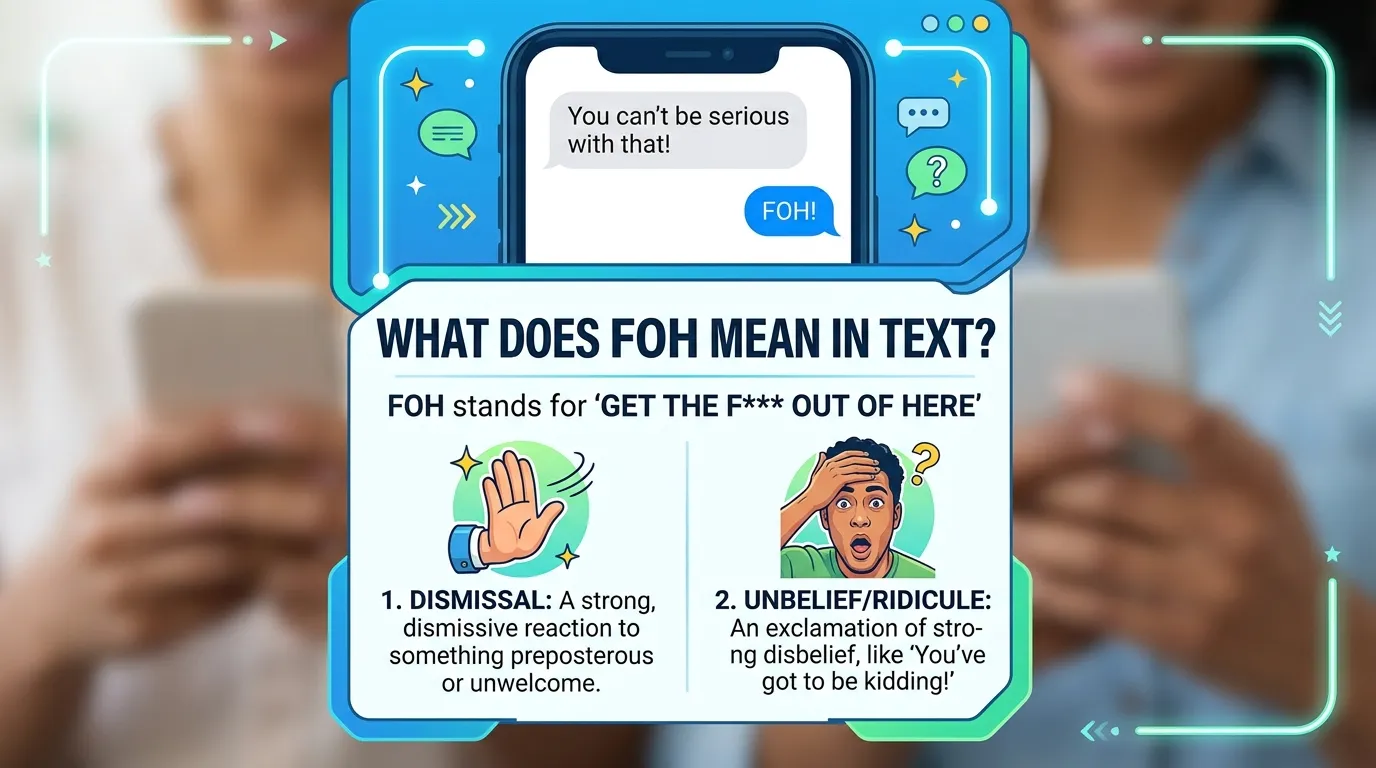
If you’ve recently come across FOH in a text message, TikTok comment, Snapchat chat, or Instagram reply, you may be wondering what it actually means. The abbreviation FOH is a popular piece of internet slang that usually stands for “F* Outta Here”** and is often used to express surprise, disbelief, frustration, or playful disagreement. Depending on the conversation, it can be humorous, sarcastic, or slightly rude.
As social media and texting continue to shape modern communication, slang terms like FOH appear more frequently in everyday conversations. Many people search for what does FOH mean in text because the meaning isn’t always obvious, especially if they’re unfamiliar with online slang culture.
Understanding FOH can help you avoid confusion when chatting with friends, reading social media comments, or participating in online discussions. In this guide, you’ll learn the real meaning of FOH, how people use it, when it’s appropriate, and how to respond when someone sends it to you.
FOH Meaning in Text
FOH is a popular internet slang abbreviation that usually means “F* Outta Here.”**
It is considered slang rather than a formal acronym. People use it in casual conversations, social media comments, memes, and online discussions.
The exact meaning depends heavily on the situation.
Sometimes FOH is used jokingly:
“You won the lottery? FOH, no way!”
In this example, the person is expressing surprise rather than anger.
Other times it can be used more aggressively:
“FOH with that nonsense.”
Here, the phrase shows irritation or disagreement.
What FOH Means in Everyday Chat
In everyday texting, FOH often communicates:
- Disbelief
- Shock
- Surprise
- Frustration
- Rejection of an idea
- Playful teasing
The tone usually determines whether the message feels funny or offensive.
Is FOH an Acronym or Slang?
Technically, FOH is an abbreviation created from a longer phrase.
However, most people simply treat it as internet slang.
Like LOL, BRB, and IDK, it has become part of online communication culture.
Where People Use FOH
FOH on TikTok
TikTok users frequently write FOH in comments when reacting to unbelievable videos.
Examples include:
- Viral pranks
- Celebrity gossip
- Unexpected results
Someone might comment:
“FOH, that can’t be real.”
The comment expresses disbelief rather than anger.
FOH on Snapchat
On Snapchat, FOH often appears in private conversations between friends.
People may use it when:
- Joking around
- Reacting to surprising news
- Teasing friends
Because Snapchat is casual, FOH is often interpreted humorously.
FOH on Instagram
Instagram users commonly use FOH in:
- Comment sections
- Direct messages
- Story replies
The abbreviation often appears when users disagree with an opinion or find something hard to believe.
FOH on WhatsApp
WhatsApp conversations tend to be more personal.
In group chats, FOH can be used among close friends as playful banter.
However, because the phrase can sound harsh, context matters.
FOH in SMS Text Messages
Traditional texting still includes slang abbreviations.
Many younger users type FOH instead of writing the full phrase because it is faster and commonly understood.
Real Chat Examples
Example 1
A: I met my favorite singer yesterday.
B: FOH.
A: Seriously, I have a picture.
Example 2
A: I finished the entire project in one hour.
B: FOH, that’s impossible.
A: I’m not kidding.
Example 3
A: I accidentally slept for 15 hours.
B: FOH.
A: It really happened.
Example 4
A: I got front-row tickets.
B: FOH, you’re so lucky.
A: I know!
Example 5
A: My phone survived the pool.
B: FOH.
A: It still works somehow.
Example 6
A: I ate three pizzas.
B: FOH.
A: I was starving.
Example 7
A: The teacher canceled the test.
B: FOH, best news ever.
A: Everyone cheered.
Example 8
A: I won $500 from a raffle.
B: FOH.
A: I’m serious.
Example 9
A: My dog learned how to open doors.
B: FOH.
A: It’s actually scary.
Example 10
A: I got promoted today.
B: FOH, congratulations.
A: Thank you.
How to Reply When Someone Says “FOH”
The best response depends on the tone of the conversation.
Funny Replies
- “I’m telling the truth!”
- “Check the receipts.”
- “Want proof?”
- “I knew you’d say that.”
Casual Replies
- “For real.”
- “Seriously though.”
- “No joke.”
- “Trust me.”
Friendly Replies
- “You don’t believe me?”
- “I thought the same thing.”
Neutral Replies
- “That’s okay.”
- “Let me explain.”
- “Here’s what happened.”
- “Fair enough.”
Is FOH Rude or Offensive?
This is one of the most common questions people ask.
The answer is: sometimes.
FOH contains a phrase that includes profanity in its original form. Because of this, some people may consider it rude.
When FOH Is Not Offensive
FOH is often harmless when:
- Used among close friends
- Shared as a joke
- Used in memes
- Expressing playful disbelief
When FOH Can Be Offensive
It may sound rude when:
- Used during arguments
- Sent to strangers
- Used in professional settings
- Directed aggressively at someone
Should You Use FOH at School or Work?
Generally, no.
Because FOH can be interpreted as profanity-based slang, it is better avoided in:
- Work emails
- Professional chats
- School assignments
- Formal communication
Stick to more neutral language when professionalism matters.
Who Uses This Term?
FOH is most popular among younger internet users.
Age Groups
The term is commonly used by:
- Teenagers
- Young adults
- Social media users
- Online gaming communities
Gen Z Usage
Gen Z users frequently use FOH in:
- TikTok comments
- Snapchat chats
- Instagram conversations
- Online communities
Common Platforms
FOH regularly appears on:
- TikTok
- Snapchat
- X (Twitter)
- Discord
How Often Does It Appear Online?
While not as common as LOL or IDK, FOH remains a recognizable slang term in many online communities.
Its popularity tends to rise during viral discussions and trending conversations.
Origin of the Term
The exact origin of FOH is difficult to pinpoint.
Like many slang expressions, it appears to have developed naturally through spoken language before becoming popular online.
Internet Culture Influence
Social media helped spread the term rapidly.
As texting became more common, users shortened longer phrases into abbreviations.
FOH became a convenient way to express disbelief or dismissal quickly.
Is the Origin Certain?
No.
There is no single documented creator of the term.
Like much internet slang, it evolved organically through everyday use.
Comparison Table
| Term | Meaning | Type | Usage | Popularity |
| FOH | F*** Outta Here | Slang | Disbelief, annoyance, surprise | Medium |
| IDK | I Don’t Know | Acronym | Expressing uncertainty | Very High |
| IDC | I Don’t Care | Acronym | Showing indifference | High |
| IMO | In My Opinion | Acronym | Sharing opinions | High |
| BRB | Be Right Back | Acronym | Temporary absence | Very High |
Real-World Usage Example
Imagine you’re chatting with a friend after school.
Your friend sends a message saying:
“I just met my favorite actor at the mall.”
The story sounds unbelievable.
You reply:
“FOH!”
In this situation, you’re not necessarily being rude. You’re simply expressing surprise and disbelief in a casual, slang-filled way.
FAQs:
What does FOH mean in text messages?
FOH usually means “F*** Outta Here” and is used to express disbelief, surprise, or annoyance.
What does FOH mean on TikTok?
On TikTok, FOH is often used in comments reacting to shocking, funny, or unbelievable content.
Is FOH slang?
Yes. FOH is considered internet slang and is commonly used in casual online conversations.
Is FOH rude or offensive?
It can be. The meaning depends on the context, tone, and relationship between the people involved.
How should you reply to FOH?
You can reply with proof, clarification, humor, or simply continue the conversation naturally.
Conclusion:
FOH is a popular slang term that usually means “F*** Outta Here.” People commonly use it to express disbelief, surprise, amusement, or frustration in text messages and social media conversations.
You’ll often see it on TikTok, Snapchat, Instagram, WhatsApp, and other online platforms. While it can be playful among friends, it may sound rude in professional or formal settings.
If you’re unsure about using FOH, consider your audience and the tone of the conversation. In casual chats, it can be a fun part of modern internet slang. In work or school environments, it’s usually best to choose a more neutral language.

Joyce Meyer is a Christian author and Bible teacher passionate about sharing biblical wisdom and faith-based insights. She contributes to getmeanings.com helping readers explore the deeper meanings of Scripture.