Have you ever received a text message that simply says “K” and wondered what the sender really meant? You’re not alone. Many people search for what does K mean in text because this single-letter reply can sometimes feel confusing.
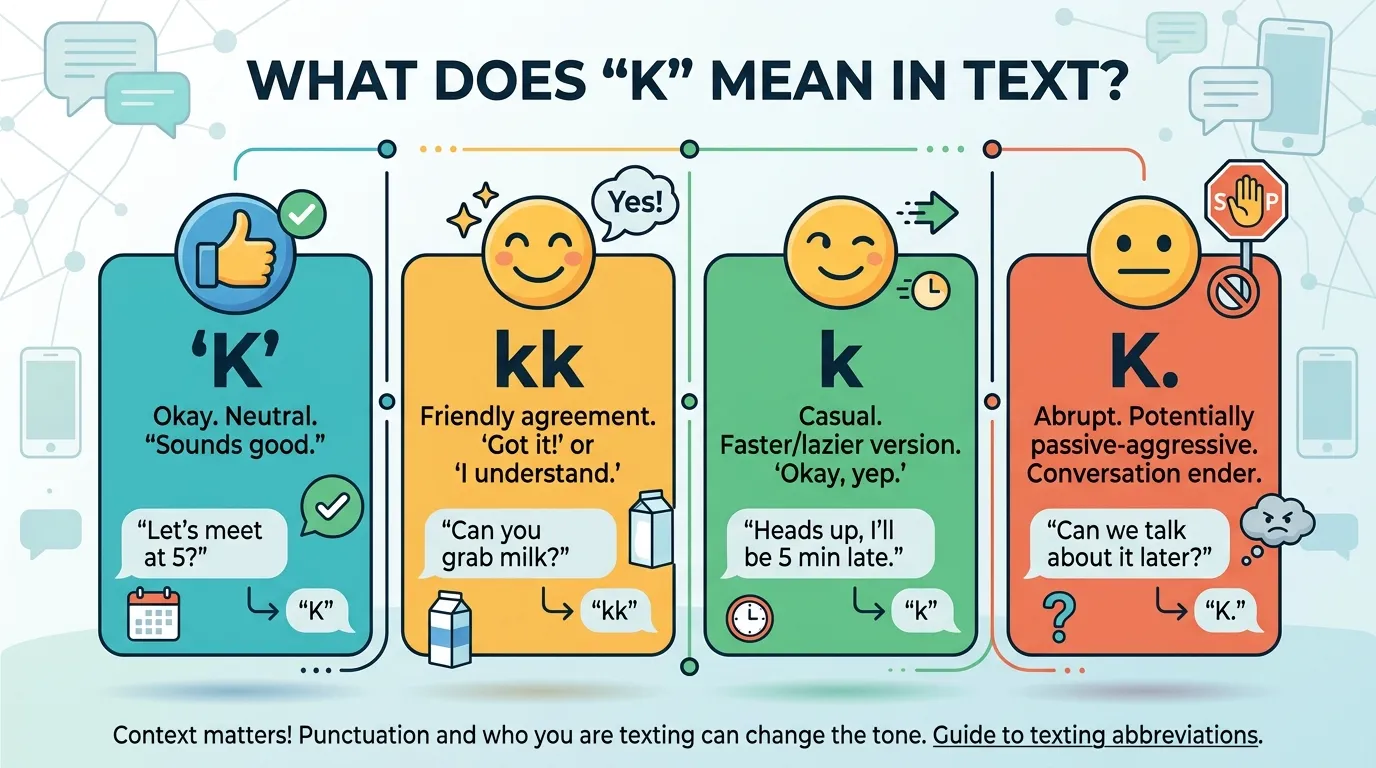
While it usually means “Okay,” its tone can vary depending on the conversation, the relationship between the people texting, and the platform being used.
Today, K is one of the most common abbreviations found in digital communication. You’ll see it on TikTok, Snapchat, Instagram, WhatsApp, Messenger, and traditional SMS conversations.
Some people use it as a quick acknowledgment, while others may interpret it as short, distant, or even slightly rude.
Understanding the meaning of K is important because context plays a major role in online communication. In this guide, you’ll learn what K means in text messages, where it’s commonly used, how people interpret it, and the best ways to respond in different situations.
K Meaning in Text
What Does K Mean?
The letter K is a shortened form of “Okay.”
It is one of the simplest and most commonly used text abbreviations online. Instead of typing the full word “okay” or “ok,” many people send a single “K” to save time.
Examples:
- “I’ll call you later.” → “K”
- “Meet me at 7?” → “K”
- “Don’t forget your keys.” → “K”
In these situations, K simply means:
- Okay
- Understood
- Got it
- Sure
- Agreed
Is K Slang an Acronym, or an Abbreviation?
K is generally considered an abbreviation rather than an acronym.
Unlike terms such as:
- LOL (Laugh Out Loud)
- BRB (Be Right Back)
- IDK (I Don’t Know)
K is simply a shortened version of an existing word.
What Does K Mean in Everyday Chat?
In daily conversations, K usually communicates quick acknowledgments.
People use it when they:
- Understand a message
- Agree with something
- Want to reply quickly
- Don’t feel the need to write a longer response
However, tone matters. A single K can sometimes sound less friendly than “Okay” or “Sounds good.”
Where People Use K
K on TikTok
On TikTok, K often appears in comments and direct messages.
Examples:
- “Posting part 2 tomorrow.”
- “K, I’ll watch.”
Many users use it casually without any negative meaning.
K on Snapchat
Snapchat conversations are usually fast and informal.
People often reply with K when:
- Confirming plans
- Acknowledging snaps
- Ending conversations
Because Snapchat messages are brief, K is extremely common.
K on Instagram
Instagram users frequently use K in:
- Direct messages
- Story replies
- Comment sections
Example:
Friend: “Check your DMs.”
You: “K.”
K on WhatsApp
WhatsApp conversations range from casual to professional.
Among friends, K is common.
In professional chats, however, using only K may sometimes seem abrupt.
K in SMS Text Messages
K has been popular since the early days of texting when mobile phones had limited keyboards.
Many people still use it today because it is fast and convenient.
Real Chat Examples
Example 1
A: Are you coming tonight?
B: K
A: Great, see you later.
Example 2
A: I’ll send the notes after class.
B: K thanks.
A: Perfect.
Example 3
A: Can you pick up some milk?
B: K
A: Appreciate it.
Example 4
A: Meeting starts at 9.
B: K.
A: Don’t be late.
Example 5
A: I finished the project.
B: K nice.
A: Thanks.
Example 6
A: Want to play later?
B: K
A: I’ll invite you.
Example 7
A: Check your email.
B: K.
A: Let me know what you think.
Example 8
A: Dinner at 8?
B: K sounds good.
A: Awesome.
Example 9
A: I might be late.
B: K no worries.
A: Thanks.
Example 10
A: I’ll text you tomorrow.
B: K.
A: Talk then.
How to Reply When Someone Says “K”
The best response depends on the conversation.
Funny Replies
- That’s the shortest reply ever 😂
- One-letter response unlocked.
- Wow, so many words today.
Casual Replies
- Cool.
- Sounds good.
- Alright.
- Got it.
Friendly Replies
- Thanks!
- Awesome, see you then.
- Perfect, talk later.
- Great!
Neutral Replies
- Understood.
- Noted.
- Okay.
- Thanks for confirming.
Is K Rude or Offensive?
Is K Rude?
Not necessarily.
Most of the time, K simply means “Okay.”
However, some people perceive it as rude because it is extremely short.
For example:
Friend: “Sorry for what happened.”
Reply: “K”
In this situation, the response may seem cold or dismissive.
Is It Safe to Use?
Yes.
K is widely used across social media and messaging platforms.
It is generally safe and acceptable in casual conversations.
Is It Appropriate at School or Work?
It depends on the situation.
Casual conversations:
- Usually fine
Professional communication:
- Better to use “Okay”
- Better to use “Sounds good”
- Better to use “Thank you”
Longer responses often appear more professional.
Who Uses This Term?
Age Groups
K is used by people of all ages.
However, younger users tend to use it more frequently in digital conversations.
Gen Z Usage
Gen Z often uses K as part of fast-paced online communication.
At the same time, Gen Z users sometimes interpret a single K as passive-aggressive depending on context.
Common Platforms
You’ll commonly see K on:
- TikTok
- Snapchat
- Facebook Messenger
- Discord
- SMS
How Often Does It Appear Online?
Very often.
K is one of the most common one-letter responses on the internet.
Millions of people use it daily.
Origin of the Term
Where Did K Come From?
K originated as a shortened form of the word “Okay.”
People began abbreviating words to make communication faster, especially during the early years of mobile texting.
Internet Culture Influence
As texting became more popular, users started shortening common words.
Examples include:
- OK → K
- Thanks → Thx
- You → U
K became part of this trend.
Is the Origin Clear?
Yes.
Unlike some internet slang terms with uncertain histories, K clearly developed as a shortened version of “Okay.”
Comparison Table
| Term | Meaning | Type | Usage | Popularity |
| K | Okay | Abbreviation | Agreement or acknowledgment | Very High |
| IDK | I Don’t Know | Acronym | Expressing uncertainty | Very High |
| IDC | I Don’t Care | Acronym | Showing indifference | High |
| IMO | In My Opinion | Acronym | Sharing opinions | High |
| BRB | Be Right Back | Acronym | Temporary absence | High |
Real-World Usage Example
Imagine you’re planning dinner with friends.
Friend: “We’re meeting at the restaurant at 7 PM.”
You quickly glance at your phone while walking into a store and reply:
“K”
In this situation, you’re simply acknowledging the message and confirming that you understand the plan.
No deeper meaning is intended.
However, if the conversation involved an emotional topic, a longer response might feel more appropriate.
FAQs:
What does K mean in text messages?
K usually means “Okay.” It is a short way to acknowledge or agree with a message.
What does K mean on TikTok?
On TikTok, K typically means “Okay” and is used in comments, direct messages, and replies.
Is K slang?
Not exactly. K is generally considered an abbreviation of the word “Okay.”
Is K rude or offensive?
Usually no. However, depending on the situation, some people may view it as cold or dismissive.
How should you reply to K?
You can reply naturally based on the conversation, such as “Great,” “Thanks,” “Sounds good,” or simply continue the discussion.
Conclusion:
K is one of the simplest and most widely used text abbreviations online. In most situations, it simply means “Okay” and is used to acknowledge, confirm, or agree with a message.
You’ll commonly see it on TikTok, Snapchat, Instagram, WhatsApp, and SMS conversations. While it isn’t usually rude, context matters. In serious or emotional conversations, a longer response may come across as more thoughtful.
If someone sends you a K, don’t overthink it. Most of the time, they’re simply saying they understood your message and moving the conversation along.

Max Lucado is a bestselling Christian author and Bible teacher known for his inspiring insights on faith and Scripture. His work is featured on getmeanings.com helping readers explore the deeper meanings of the Bible.